
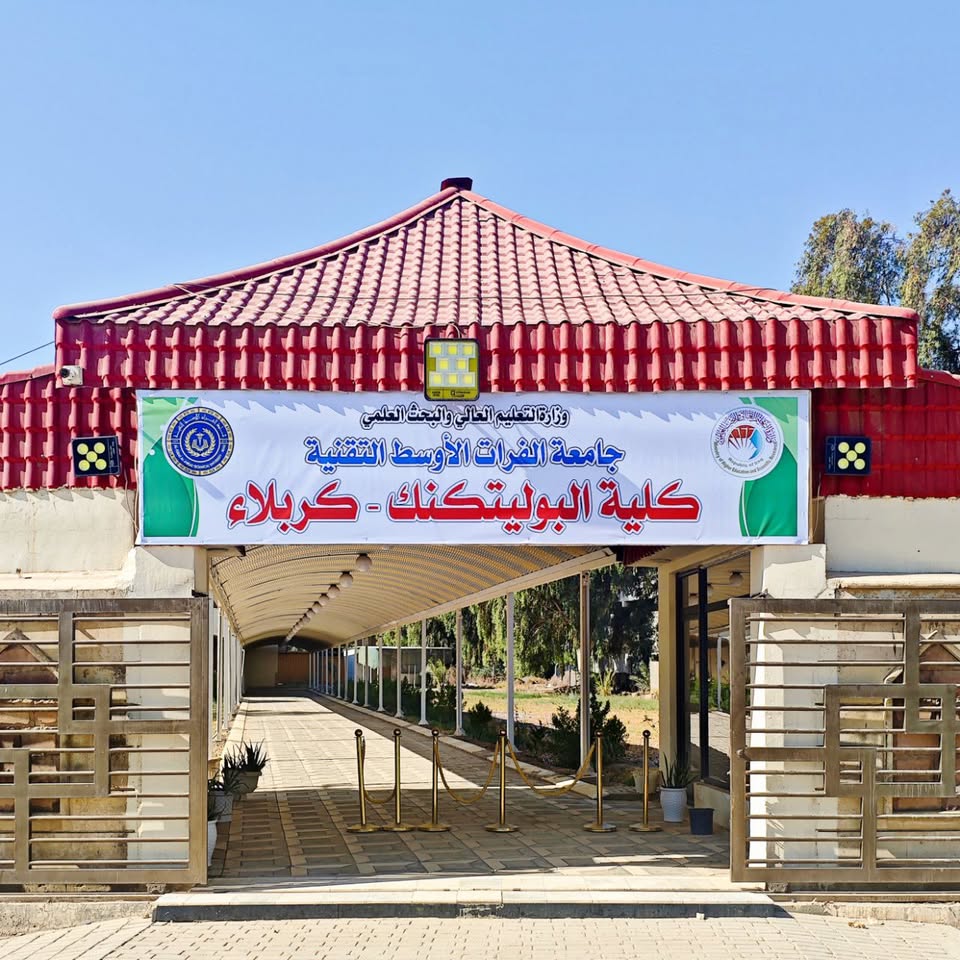
Vision, Mission and Goals
Polytechnic College – KarbalaVision
Advancing a technical education system that achieves leadership and excellence, focuses on meeting the needs of society, and relies on quality standards and sustainable development.
Mission
Providing society with qualified technical personnel who possess experience and competence, delivering technical education based on quality standards and academic accreditation, and strengthening scientific research in a way that meets labor-market requirements.
Values
Integrity and respect.
Ethical and social responsibility.
Loyalty and belonging.
Academic freedom.
Teamwork.
Quality and excellence.
Authenticity and innovation.
Transparency and accountability.
Goals
Karbala Polytechnic College aims to achieve the following:
First: In the field of technical education
Preparing mid-level technical staff with high, diverse qualifications capable of working with modern technologies that meet the needs of the work environment.
Attracting human resources able and willing to pursue technical education, whether from secondary-school graduates or those seeking to acquire professions and skills.
Monitoring the labor market’s varying needs for technical education graduates and preparing the programs required to meet them and adapt to changing conditions.
Achieving national and international academic accreditation for the college’s academic programs.
Furthermore, using a range of modern teaching and learning methods and maintaining effective communication with students to strengthen the student–university relationship.
Second: In the field of scientific research
Engaging with scientific institutions to exchange views and expertise in pursuit of shared goals.
Advancing the college’s staff to build a distinguished professionalism reflected in the quality of its output, through scientific courses, discussion panels, and workshops across various fields.
Supporting scientific research by providing the facilities needed to complete research and nurturing innovators in a way that generates knowledge and delivers services meeting quality standards.
Helping spread a culture of technical education through field visits to vocational schools.
Linking research and its results to sustainable-development plans and finding scientific solutions to the country’s social, economic, and technical problems.
Encouraging faculty members to work as research teams and strengthening partnerships with various scientific institutions to raise the university’s global standing.
Third: In the field of community service
Continuously evaluating specializations in scientific departments – suspending some or creating new departments – to keep pace with labor-market developments and community needs.
Meeting social-responsibility requirements and maintaining an influential presence in community events and activities to advance social, cultural, scientific, and economic progress.
Directing the university’s consulting and research offices to provide purposeful advisory services that strengthen the university’s leading role in society.
Providing continuous education and training programs for institutions and segments of society, and striving to spread scientific culture.
Fourth: In the field of cooperation with universities and other scientific institutions
Supporting cooperation with international universities in scientific research, cultural exchange, and joint supervision of postgraduate studies to develop faculty and student capabilities.
Building a network of strategic relationships with reputable universities and scientific institutions that helps develop educational and research capabilities and programs.
Sustaining cooperation with supporting institutions to hold scientific seminars and conferences that spread knowledge, innovation, and technology transfer.
Engaging with international scientific experience and expertise in scientific and technical fields.
Fifth: In the field of performance evaluation and global rankings
Adopting the highest evaluation standards, institutionally and programmatically, to meet the university’s total-quality-management requirements.
Providing the fundamental requirements for advancing the university’s position within global rankings.
Building the infrastructure needed to implement the e-government project, facilitating electronic communication between the institute’s units and other departments.
Developing programs to build faculty members’ capabilities, improve their performance, and create the incentives needed to support that.
Enhancing the university’s academic reputation by encouraging researchers to participate in research platforms and publish their scientific work.
Sixth: In the field of providing an attractive university environment
Improving infrastructure and services and sustaining them in line with national and international academic accreditation standards.
Developing and maintaining green spaces at the institute in line with green-university standards to improve the campus environment for students.
Developing information-technology services and applications at the institute to enable fast communication between the institute and its students.
Facilitating knowledge sharing by developing the university’s virtual library project and linking it to an electronic application that makes it easy for students to access the books and research they need.